A scientifically accurate, metaphor-rich story for everyday readers
Prologue — The House of Energy Balance
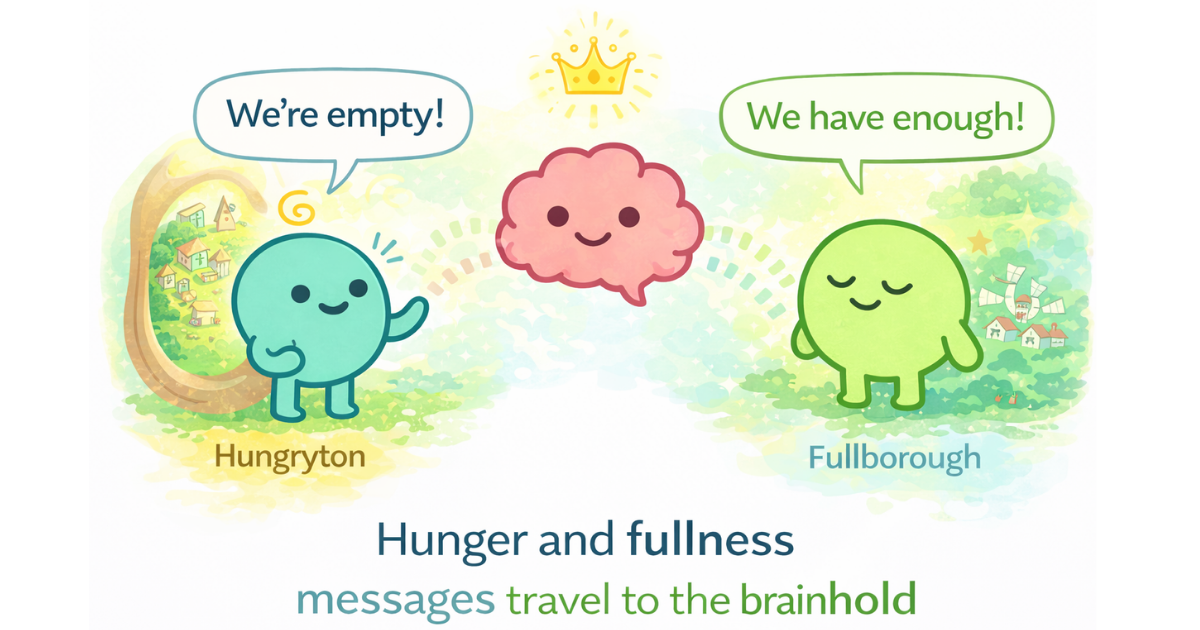
Inside your body lives a bustling kingdom where countless biological processes work together to keep you alive. Deep within this kingdom sits a place we might call the House of Energy Balance. Here, two important hormones are born: Ghrelin and Leptin.
They are brothers in origin, but raised in very different cities:
- Ghrelin grows up in Hungryton, your stomach — quick to sense emptiness.
- Leptin grows up in Fullborough, your fat tissue — steady, observant, long-term focused.
Despite the distance, they share the same purpose: to regulate hunger, fullness, and energy use each day.

I. Ghrelin of Hungryton — The Hunger Herald
When Hungryton senses emptiness, Ghrelin springs into action.
Ghrelin levels rise predictably before meals [1][2], which is why hunger often follows a familiar rhythm.
He rushes to Brainhold — the kingdom’s capital — calling:
“Fuel is low. Time to eat.”
Scientifically, ghrelin activates NPY/AgRP neurons in the hypothalamus, increasing hunger and motivating food-seeking behavior [3].
Mid-morning cravings or late-night snack urges are often Ghrelin simply doing his job.
II. Leptin of Fullborough — The Guardian of Fullness
Leptin has a calmer, steadier temperament.
Fat cells release leptin in proportion to how much energy is stored [4][5]. When Leptin reaches Brainhold, he reassures the council:
“We have enough. You can stop eating.”
Leptin activates POMC/CART neurons, promoting fullness and supporting energy expenditure [6].
This is why a complete meal can lead to a natural sense of satisfaction — not through discipline, but through clear signaling.
III. Brainhold — Where the Messages Are Interpreted
Each day, Ghrelin and Leptin send their messages to Brainhold. The council considers:
- hormone signals
- emotional cues
- sensory input
- metabolic needs
- circadian rhythms

…and determines whether you feel hungry, comfortable, or satisfied.
When Ghrelin’s voice grows louder, hunger rises.
When Leptin’s message comes through clearly, appetite softens.
Most days, this balance operates quietly in the background.
IV. When the Signal Gets Buried — Understanding Leptin Resistance
As the kingdom prospers, Leptin sends more and more messages to Brainhold. At first, everything works smoothly.
But gradually, the environment around the receiver changes.
Leptin is still speaking — clearly and consistently — but the space around Brainhold grows louder.
Imagine the fullness signal traveling through a room filled with rising white noise:
- constant stimulation
- overlapping hormonal signals
- background inflammation
- disrupted timing
The message isn’t gone.
It’s simply harder to hear.
Brainhold begins to mistake signal for silence — not because leptin stopped speaking, but because the noise floor rose.
This is leptin resistance.
It means:
- leptin levels are often high
- but the brain behaves as if leptin were low [4][7]
- hunger increases
- fullness feels delayed or muted
- eating less feels harder than expected
The issue is not willpower.
It is a signal-to-noise problem inside the system.
V. Sources of Noise in the System
Several biological forces raise the noise floor around leptin’s message:
1. Inflammation in Brainhold
Inflammation in the hypothalamus reduces leptin receptor sensitivity and increases background interference [5].
2. Reward System Overload
Highly processed foods generate strong dopamine signals that drown out leptin’s quieter fullness message.
3. Insulin Resistance
Leptin and insulin share signaling pathways; when insulin signaling degrades, cross-talk and interference increase [7][8].
4. Circadian Disruption
Late or irregular eating causes signals to overlap instead of arriving in sequence, blurring timing cues.
5. Sleep Deprivation
Even a single short night lowers leptin and raises ghrelin [9], increasing hunger while reducing signal clarity.
None of these silence leptin.
They make it harder to distinguish from the noise.
VI. Seeing Hunger Differently
When hunger feels loud, confusing, or relentless, it is tempting to assume something is broken.
But hunger is not a flaw.
Fullness is not a virtue.
Appetite is a communication network.
When the system is quiet, signals are easy to interpret.
When the system is loud, hunger dominates — even when energy is stored.
Understanding this distinction changes how hunger is experienced.
Final Thought
Your hunger is not random.
It is a signal moving through a noisy environment.
Before anything can change, the noise has to be understood.
This is the beginning of that understanding.
The first doorway
Note, if you’re reading this and thinking, “This didn’t used to feel so complicated”…
I’m slowly putting together an early-access guide called Anti–Yo-Yo Diet Guide (v0.7) for that exact season, when the signals change and effort stops working the same way.
It’s there quietly, if you want to step deeper: Link
References
1. Cummings DE, Purnell JQ, Frayo RS, Schmidova K, Wisse BE, Weigle DS. (2001). A preprandial rise in plasma ghrelin levels suggests a role in meal initiation in humans. Diabetes. PMID: 11473029
2. Drazen DL, Vahl TP, D’Alessio DA, Seeley RJ, Woods SC. (2006).
Effects of a fixed meal pattern on ghrelin secretion: evidence for a learned response independent of nutrient status. Endocrinology. PMID: 16179409
3. Cowley MA, Smith RG, Diano S, et al. (2003). The distribution and mechanism of action of ghrelin in the CNS demonstrates a novel hypothalamic circuit regulating energy homeostasis. Neuron. PMID: 12597862
4. Considine RV, Sinha MK, Heiman ML, et al. (1996). Serum immunoreactive-leptin concentrations in normal-weight and obese humans. New England Journal of Medicine. PMID: 8532024
5. Myers MG Jr, Heymsfield SB, Haft C, et al. (2012). Challenges and opportunities of defining clinical leptin resistance. Cell Metabolism. PMID: 22326217
6. Schwartz MW, Woods SC, Porte D Jr, Seeley RJ, Baskin DG. (2000).
Central nervous system control of food intake. Nature. PMID: 10766253
7. Banks WA, DiPalma CR, Farrell CL. (1999). Impaired transport of leptin across the blood–brain barrier in obesity. Peptides. PMID: 10612449
8. Morton GJ, Cummings DE, Baskin DG, Barsh GS, Schwartz MW. (2006). Central nervous system control of food intake and body weight.
Nature. PMID: 16988703
9. Spiegel K, Tasali E, Penev P, Van Cauter E. (2004). Brief communication: sleep curtailment in healthy young men is associated with decreased leptin levels, elevated ghrelin levels, and increased hunger. Annals of Internal Medicine. PMID: 15583226

You must be logged in to post a comment.