How stress quietly reorders your appetite
Hunger isn’t a single signal.
It’s a conversation.
Inside the body, multiple biological systems are constantly messaging the brain about energy availability, reward, timing, and safety. Some signals are urgent. Some are subtle. Some arrive quietly and assume they’ll be heard. Most of the time, these messages arrive in sequence and make sense together. Under stress, they don’t. [1,2]
To understand why hunger can feel louder, faster, or more confusing during busy or pressured moments, it helps to imagine appetite as a shared chat — with different voices, different styles, and one quiet administrator deciding what gets seen first.
What follows is a snapshot of that conversation.
Not a metaphor for behavior.
A model for how biological signals shift in service of relief when system load increases. [2]
Meet Cortisol
Cortisol doesn’t cheer.
He doesn’t argue.
He doesn’t crave.
Cortisol monitors load.
Biologically, cortisol is released by the hypothalamic–pituitary–adrenal (HPA) axis in response to stress. His role isn’t appetite control. His role is pressure management. When demands rise — cognitive, emotional, environmental — cortisol reallocates attention and resources to help the system unload strain and keep functioning.
In other words:
Cortisol doesn’t decide what you want.
He decides what will bring relief fastest. [3,4]
Group Chat: Appetite
Participants: Ghrelin, Leptin, Dopamine, Insulin, Cortisol
09:12 AM — Morning, Low Load
Ghrelin:
GOOD MORNING
TIME TO EAT
Leptin:
energy stores are adequate. no action required.
Dopamine:
✨☕💖 MORNING COFFEE VIBES 💖☕✨
Insulin:
📦➡️🏠
(translation: incoming energy moving smoothly into cells)
🟢
(translation: flow is clear)
Cortisol:
system stable

12:47 PM — Lunch Window
Ghrelin:
HELLO
IT IS LUNCH O’CLOCK
Leptin:
we are still within range. satiety should follow shortly.
Dopamine:
⭐🍽️ REMEMBER THAT PLACE 🍽️⭐
🔥 SO GOOD 🔥
Insulin:
📦➡️🏠
(translation: energy being routed into cells)
▶️
(translation: movement proceeding normally)
Cortisol:
load nominal
3:18 PM — Afternoon Pressure Begins
Deadlines stack.
Notifications multiply.
Mental load rises.
The system starts looking for relief.
Ghrelin:
HEY
ANYONE ELSE FEELING THIS
Leptin:
technically no fuel deficit detected
Dopamine:
🥔🥔🥔
💖 JUST SAYING 💖
✨ THIS COULD FEEL GOOD ✨
Insulin:
⏸️
(translation: pause energy movement while signals stack)
🚦🟡
(translation: slow down — multiple signals arriving)
Cortisol:
system load increasing
relief pathways under review
Admin Action Logged — Priority Stack Update
- low-effort relief signals elevated
- high-bandwidth signals delayed
3:19 PM — Under Load
Leptin:
(message depriortized)
Ghrelin:
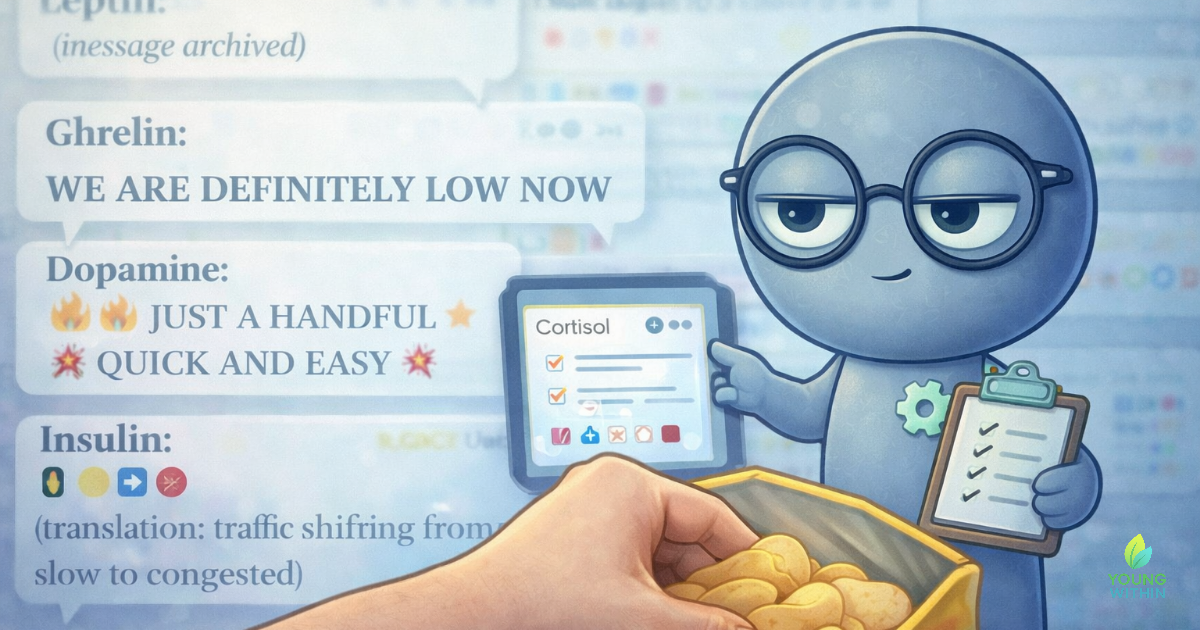
WE ARE DEFINITELY LOW NOW
Dopamine:
🔥🔥🔥
⭐ JUST A HANDFUL ⭐
💥 QUICK AND EASY 💥
Insulin:
🚦🟡➡️🔴
(translation: traffic shifting from slow to congested)
📦📦📦
(translation: large amounts of energy arriving at once)
The bag of chips is opened.
No debate.
No announcement.
Just crinkling.

And then —
Oh.
I ate a lot of those.
Where did they go?
Awareness arrives late.
Relief arrived first.
3:21 PM — Post-Action
Dopamine:
🎉 YES YES YES 🎉
…
oh
that was fast
Ghrelin:
…OKAY
QUIET NOW
Leptin:
(message pending.)
Insulin:
🔄
(translation: redistributing and cleaning up after intake)
⏸️
(translation: holding while the system stabilizes)
Cortisol:
event recorded
temporary relief achieved
system strain reduced
What Just Happened
Nothing here was a failure of willpower.
Under stress, cortisol increases available energy, narrows focus, and favors actions that reliably bring short-term relief. Subtle, long-range signals — like leptin’s fullness message — require time and cognitive bandwidth to register, so they’re delayed. Hunger signals are simple and urgent. Reward cues promise immediate relief. Directional signals still operate, but traffic compresses.
Cortisol doesn’t silence fullness.
He temporarily prioritizes relief. [3–8]
This is why stress eating often feels automatic and soothing in the moment — even when it doesn’t improve how you feel afterward. [4,7]
Why It Didn’t Feel Like a Choice
By the time awareness arrived, the relief had already been delivered.
Logic wasn’t gone.
Fullness wasn’t wrong.
They were simply queued behind urgency. [3,4]
When the System Calms
As pressure drops, cortisol activity recedes. Relief is no longer urgent. The priority stack resets. Signals resume their usual sequence.
Hunger feels specific.
Fullness registers clearly.
Decisions slow down — because they can. [1,3,6]
Nothing was repaired.
The system just didn’t need emergency relief anymore. [3,4]
Closing Log Entry
Cortisol isn’t sabotaging your appetite.
He’s helping the system offload stress when demand spikes.
If hunger feels louder during pressure, it’s not because something went wrong.
It’s because the system chose relief first. [3,4]
for readers who want more detail
Science Notes
How cortisol actually works
Cortisol is released through the hypothalamic–pituitary–adrenal (HPA) axis in response to physical, emotional, or cognitive stress. Its primary role is not appetite control, but maintaining stability under load by reallocating energy, attention, and resources.
[3]
Why stress changes appetite
Under stress, cortisol increases available glucose, narrows attention, and favors fast, familiar actions that reliably reduce strain. Subtle signals like fullness require more time and bandwidth to register.
[3,4]
Why stress eating can feel relieving
Highly palatable foods activate reward pathways that briefly dampen stress responses. This short-term relief is biologically real, even if it doesn’t last or improve long-term well-being.
[4,7]
Why this isn’t about willpower
The brain prioritizes urgency and relief before reflection. By the time conscious awareness arrives, the action may already be complete.
[4]
Where the other signals fit
- Ghrelin signals immediate energy need [5]
- Leptin provides long-range information about stored energy [6,9]
- Dopamine amplifies anticipation and salience [7]
- Insulin directs fuel into tissues and manages metabolic flow [8]
The room gets noisy
If stress has been turning the volume up lately…
That’s part of why I’m writing Anti–Yo-Yo Diet (v0.7), a calm companion for the chapter of life where appetite feels louder and the body feels harder to settle.
Founding readers receive updates as it grows: [link]
References
1. Schwartz MW, Woods SC, Porte D Jr, Seeley RJ, Baskin DG. (2000). Central nervous system control of food intake. Nature. PMID: 10766253.
2. Morton GJ, Cummings DE, Baskin DG, Barsh GS, Schwartz MW. (2006). Central nervous system control of food intake and body weight. Nature. PMID: 16988703.
3. Ulrich-Lai YM, Herman JP. (2009). Neural regulation of endocrine and autonomic stress responses. Nature Reviews Neuroscience. PMID: 19469025.
4. Dallman MF, Pecoraro N, Akana SF, et al. (2003). Chronic stress and obesity: a new view of “comfort food”. Proceedings of the National Academy of Sciences USA. PMID: 12975524.
5. Cummings DE, Purnell JQ, Frayo RS, Schmidova K, Wisse BE, Weigle DS. (2001). A preprandial rise in plasma ghrelin levels suggests a role in meal initiation in humans. Diabetes. PMID: 11473029.
6. Considine RV, Sinha MK, Heiman ML, et al. (1996). Serum immunoreactive-leptin concentrations in normal-weight and obese humans. New England Journal of Medicine. PMID: 8532024.
7. Volkow ND, Wang GJ, Baler RD. (2011). Reward, dopamine and the control of food intake: implications for obesity. Trends in Cognitive Sciences. PMID: 21109477.
8. Morton GJ, Meek TH, Schwartz MW. (2014). Neurobiology of food intake in health and disease. Nature Reviews Neuroscience. PMID: 24840801.
9. Myers MG Jr, Heymsfield SB, Haft C, et al. (2012). Challenges and opportunities of defining clinical leptin resistance. Cell Metabolism. PMID: 22326217.

You must be logged in to post a comment.